office in the present year, he died in the 71st year of his age, leaving several children. (He had 6 sons by his first wife, after her death married again and had another 6 sons and 5 daughters)
The DNB says of him that he was a learned and able judge, with a handsome presence and courteous manners.
IMAGE
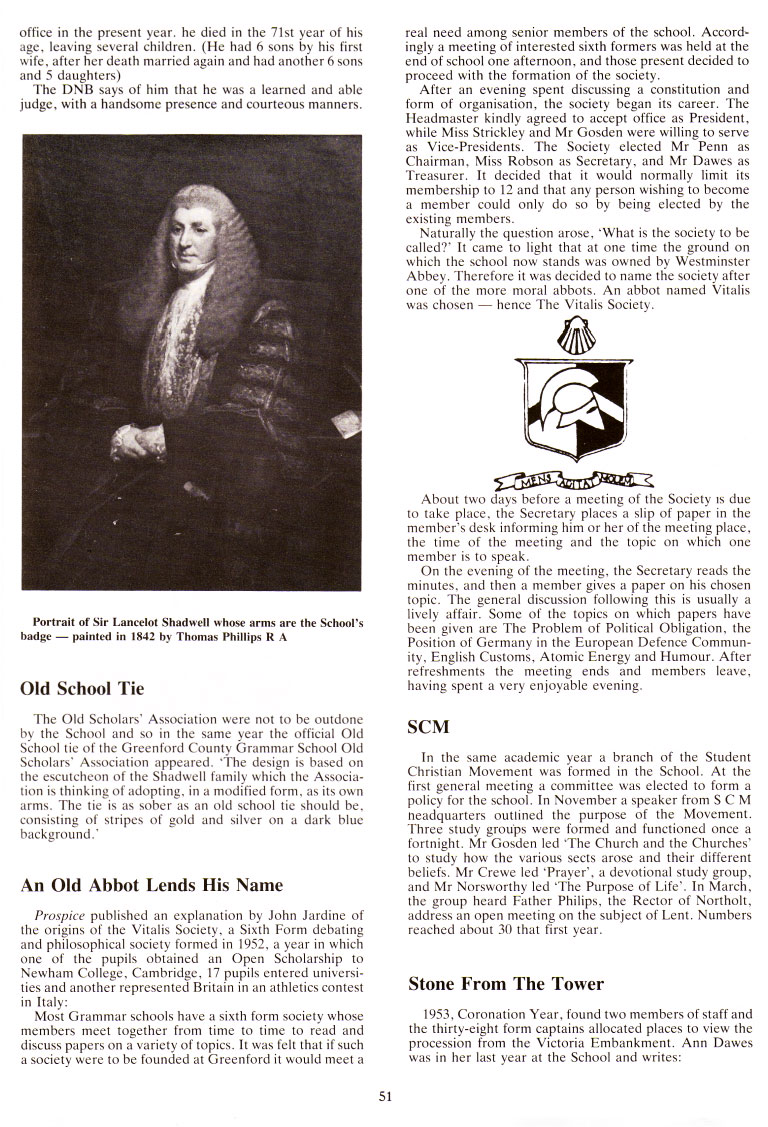
Portrait of Sir Lancelot Shadwell whose arms are the School's badge painted in 1842 by Thomas Phillips R A
Old School Tie
The Old Scholars' Association were not to be outdone by the School and so in the same year the official Old School tie of the Greenford County Grammar School Old Scholars' Association appeared. 'The design is based on the escutcheon of the Shadwell family which the Association is thinking of adopting, in a modified form, as its own arms. The tie is as sober as an old school tie should be, consisting of stripes of gold and silver on a dark blue background.'
An Old Abbot Lends His Name
Prospice published an explanation by John Jardine of the origins of the Vitalis Society, a Sixth Form debating and philosophical society formed in 1952, a year in which one of the pupils obtained an Open Scholarship to Newham College, Cambridge, 17 pupils entered universities and another represented Britain in an athletics contest in Italy:
Most Grammar schools have a sixth form society whose members meet together from time to time to read and discuss papers on a variety of topics. It was felt that if such a society were to be founded at Greenford it would meet a real need among senior members of the school. Accordingly a meeting of interested sixth formers was held at the end of school one afternoon, and those present decided to proceed with the formation of the society.
After an evening spent discussing a constitution and form of organisation, the society begant its career. The Headmaster kindly agreed to accept office as President, while Miss Strickley and Mr Gosden were willing to serve as Vice-Presidents. The Society elected Mr Penn as Chairman, Miss Robson as Secretary, and Mr Dawes as Treasurer. It decided that it would normally limit its membership to 12 and that any person wishing to become a member could only do so by being elected by the existing members.
Naturally the question arose, 'What is the society to be called?' It came to light that at one time the ground on which the school now stands was owned by Westminster Abbey. Therefore it was decided to name the society after one of the more moral abbots. An abbot named Vitalis was chosen hence The Vitalis Society.
IMAGE
About two days before a meeting of the Society is due to take place, the Secretary places a slip of paper in the member's desk informing him or her of the meeting place, the time of the meeting and the topic on which one member is to speak.
On the evening of the meeting, the Secretary reads the minutes, and then a member gives a paper on his chosen topic. The general discussion following this is usually a lively affair. Some of the topics on which papers have been given are The Problem of Political Obligation, the Position of Germany in the European Defence Community, English Customs, Atomic Energy and Humour. After refreshments the meeting ends and members leave, having spent a very enjoyable evening.
SCM
In the same academic year a branch of the Student Christian Movement was formed in the School. At the first general meeting a committee was elected to form a policy for the school. In November a speaker from S C M headquarters outlined the purpose of the Movement. Three study groups were formed and functioned once a fortnight. Mr Gosden led 'The Church and the Churches' to study how the various sects arose and their different beliefs. Mr Crewe led 'Prayer', a devotional study group, and Mr Norsworthy led 'The Purpose of Life'. In March, the group heard Father Philips, the Rector of Northolt, address an open meeting on the subject of Lent. Numbers reached about 30 that first year.
Stone From The Tower
1953, Coronation Year, found two members of staff and the thirty-eight form captains allocated places to view the procession front the Victoria Embankment. Ann Dawes was in her last year at the School and writes:
page 51


 Page 51