Shadwell was traced. The school would do well to remember that the crest was first granted to her family in 1537. He congratulated those concerned with the making of the shields on a fine piece of craftsmanship.
The local newspaper carried a note about the adoption of the arms by the School:
That was a nice gesture of Miss Shadwell's made known at Greenford Grammar School speech day to allow her 400-year-old family crest to be used as the school's badge. Miss Shadwells family used to include the lords of the manor of Northolt on the edge of which the school stands and from where it draws many of its pupils. As the Headmaster pointed out, Borough and County crests are already used by schools, and the adoption of a family crest of local antiquity is a pleasantly varied innovation.
This is another graceful recognition of the fact that public bodies are taking over functions formerly discharged by leading families, and that they ought to take over ornamental as well as utilitarian responsibilities. Moreover, children growing up in newly urbanised districts are liable to be indifferent to local history and it is an important part of education to emphasise that history begins at home.
The Badge of Pilgrims
Prospice No 7 Autumn 1950 (the first to have the school badge on the cover) contains more information about the badge itself:
The land on which the School is built was once part of the estate of the Lord of the Manor of Northolt. . . (the earlier history of which is too long and complicated a story to relate here we'll leave it to the History classes to unravel in their Local History investigations.)
In 1827 the manor and its lands were sold by lot. The manor was bought by Sir Lancelot Shadwell, the Vice-Chancellor of England and the last man to hold this office, and his family continued to hold the manor until 1927. . .
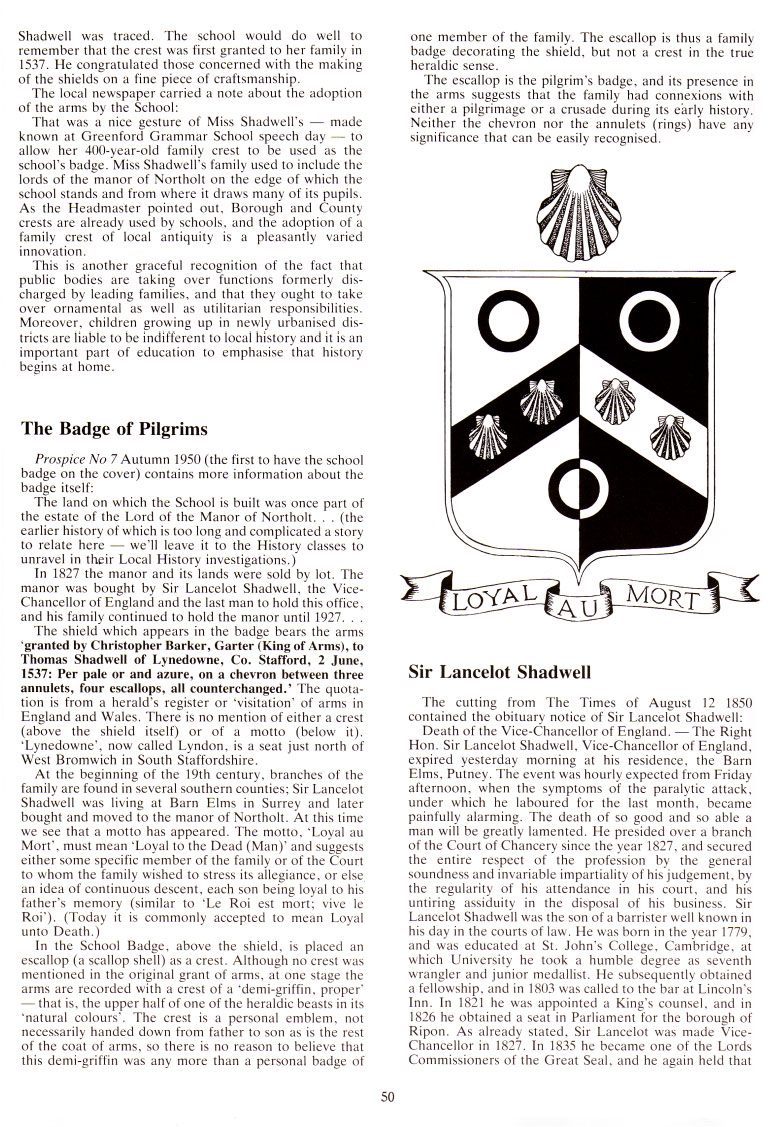
The shield which appears in the badge bears the arms 'granted by Christopher Barker, Garter (King of Arms), to Thomas Shadwell of Lynedowne, Co, Stafford, 2 June, 1537: Per pale or and azure, on a chevron between three annulets, four escallops, all counterchanged.' The quotation is from a herald's register or 'visitation' of arms in England and Wales. There is no mention of either a crest (above the shield itself) or of a motto (below it). Lynedowne.. now called Lyndon, is a seat just north of West Bromwich in South Staffordshire.
At the beginning of the 19th century, branches of the family are found in several southern counties; Sir Lancelot Shadwell was living at Barn Elms in Surrey and later bought and moved to the manor of Northolt. At this time we see then a motto has appeared. The motto, 'Loyal an Mort', must mean 'Loyal to the Dead (Man)' and suggests either some specific member of the family or of the Court to whom the family wished to stress its allegiance, or else an idea of continuous descent, each son being loyal to his father's memory (similar to 'Le Roi est mort; vive le Roi'). (Today it is commonly accepted to mean Loyal unto Death.)
In the School Badge, above the shield, is placed escallop (a scallop shell) as a crest. Although no crest was mentioned in the original grant of arms, at one stage the arms are recorded with a crest of a 'demi-griffin, proper' that is, the upper half of one of the heraldic beasts in its 'natural colours'. The crest is a personal emblem, not necessarily handed down from father to son as is the rest of the coat of arms, so there is no reason to believe that this demi-griffin was any more than a personal badge of one tnember of the family. The escallop is thus a family badge decorating the shield. but not a crest in the true heraldic sense.
The escallop is the pilgrim's badge, and its presence in the arms suggests that the family had connexions with either a pilgrimage or a crusade during its early history. Neither the chevron nor the annulets (rings) have any significance that can be easily recognised.
IMAGE
Sir Lancelot Shadwell
The cutting from The Times of August 12 1850 contained the obituary notice of Sir Lancelot Shadwell:
Death of the Vice-Chancellor of England. The Right Hon. Sir Lancelot Shadwell, Vice-Chancellor of England, expired yesterday morning at his residence, the Barn Elms, Putney. The event was hourly expected from Friday afternoon, when the symptoms of the paralytic attack, under which he laboured for the last month, became painfully alarming. The death of so good and so able a man will be greatly lamented. He presided over a branch of the Court of Chancery since the year 1827, and secured the entire respect of the profession by the general soundness and invariable impartiality of his judgement, by the regularity of his attendance in his court, and his untiring assiduity in the disposal of his business. Sir Lancelot Shadwell was the son of a barrister well known in his day in the courts of law. He was born in the year 1779, and was educated at St. John's College, Cambridge, at which University he took a humble degree as seventh wrangler and junior medallist. He subsequently obtained a fellowship, and in 1803 was called to the bar at Lincoln's Inn. In 1821 he was appointed a King's counsel, and in 1826 he obtained a seat in Parliament for the borough of Ripon. As already stated. Sir Lancelot was made Vice-Chancellor in 1827. In 1835 he became one of the Lords Commissioners of the Great Seal, and he again held that
page 50


 Page 50