The Upper 6th in 1953, while up on the roof of the Tower, nearly injured Mr James, the Headmaster when one of their number 'inadvertently' tossed a stone over the edge. It nearly penetrated the glass roof of the vestibule under which Mr James was walking. After that, 6U were banned from taking the time-honoured climb up the Tower on the last day of term. What a shame, it was quite an honour.
All past pupils agree GGS was a wonderful place and the number of Old Scholars who married fellow Greenfordians, surely bears witness to the 'friendliness' (for want of a better word) of the place. The teachers all seemed so interested and they fired so much enthusiasm in the pupils, that certainly most of the 1953 leavers went on to University and College Derek Dawes going to Oxford and Robert Horsley and D G Noel to Cambridge, quite a good record!
Oddly enough we, the 1946 intake, were the first to do 0 Levels and the Dawes twins, Alyson and Susannah, aged 18, were the last! They also attended a similar school and they have made what we think may be lasting friendships, as we did.
How to Start a Philatelic Society. . .?
By 1954 (a year in which John Game and Terence Maddern represented Middlesex in the AllEngland Athletics Meet in July), G Dunkin had been thinking about the idea of a society for stamp-collectors for some time and had succeeded in interesting several people I knew, mainly in my own form. At first, we started a campaign by chalking 'Watch out for the P.S.' on most of the blackboards. Having done this, we were a trifle at a loss to know what to do next. We did eventually, however, get two members of staff interested in the idea and we were advised to see Mr James and get his approval. We therefore did this, and a few days later it was announced from the platform at Assembly that there would be a meeting of all people interested in forming a Philatelic Society. At that meeting 72 people were present and were told by Mr Owens of the basic ideas of the Society. That is, to give all the stamp-collectors of the school a chance to get together with philatelists other than those in their own form, to have meetings and discussions on various items; and to have a subscription to pay for equipment that would be too dear for any one person to buy. A committee of four was elected.
A meeting was held as soon as possible in the new term at which about 30 people were present. Mr Owens gave a talk on Thematic Collecting, illustrated by stamps kindly lent to us. Two more people were elected to the committee but one has since left us and a replacement will have to be found. After the meeting, most of the members spent some time selling, buying or exchanging stamps.
A short gathering was held at dinnertime a week or two later at which all members were asked to vote on whether or not they would be willing to pay a subscription of 3d per term. This was agreed almost unanimously. We decided however that the first 3d should cover the Easter and Summer terms as few meetings had been held so far that term. We also decided that anyone not having paid their first subscription by the end of the summer term should be considered as not a member of the Society.
Our second open meeting was rather a disappointment. Only 15 members were present, because at least 12 members were in detention and there was a house basketball match the same evening. At the meeting however, Groom gave a talk and an exhibition on the commemorative stamps of the Commonwealth, followed by at short talk about the New Zealand Centennial set of 1940 given by Dunkin.
At this meeting it was also announced that a short quiz on the stamps of the Commonwealth had beent written out, and would be available soon to anyone who wanted one. As only 15 people heard this announcement and as there was a delay in printing copies, not everyone who wished was able to have a copy.
Alas, I can find no further reference to this Society! In the mid '70s Miss Whalen (Mrs Rees) and Mrs Morris with the help of Michael Grubb ran a Stamp Club for a year or two but not nearly so well organised as the above!
All the World's a Stage
The late 'Forties and 'Fifties saw numerous dramatic and musical productions. Even the Old Scholars Association formed the Prospect Players which became renowned for its productions. Only a few of each can be mentioned here:
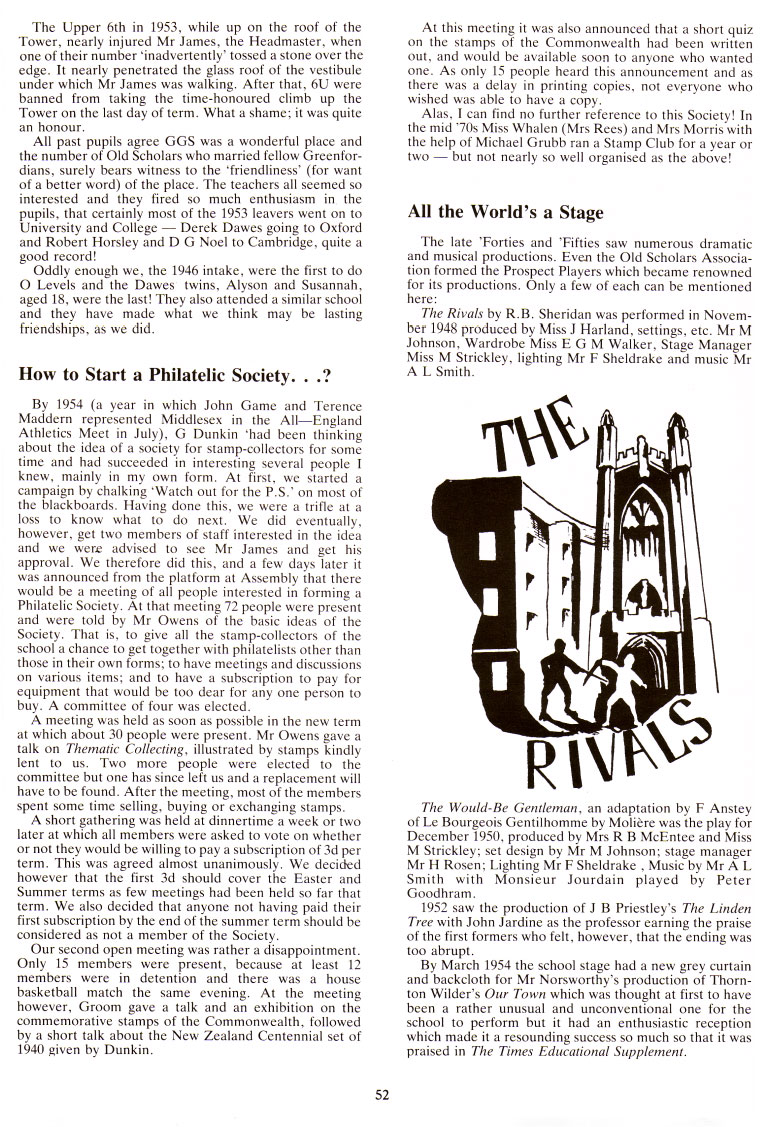
The Rivals by R.B. Sheridan was performed in November 1948 produced by Miss J Harland, settings, etc. Mr M Johnson,. Wardrobe Miss E G M Walker, Stage Manager Miss M Strickley, lighting Mr F Sheldrake and music Mr A L Smith.
IMAGE
The Would-Be Gentleman, an adaptation by F Anstey of Le Bourgeois Gentillsomme by Moliere was the play for December 1950, produced by Mrs R B McEntee and Miss M Strickley, set design by Mr M Johnson; stage manager Mr H Rosen; Lighting Mr F Sheldrake, Music by Mr A L Smith with Monsieur Jourdain played by Peter Goodhram.
1952 saw the production of J B Priestley's The Linden Tree with John Jardine as the professor earning the praise of the first formers who felt, however, that the ending was too abrupt.
By March 1954 the school stage had a new grey curtain and backcloth for Mr Norsworthy's production of Thornton Wilder's Our Town which was thought at first to have been a rather unusual and unconventional one for the school to perform but it had an enthusiastic reception which made it a resounding success so much so that it was praised in The Times Educational Supplement.
page 52


 Page 52