IMAGE
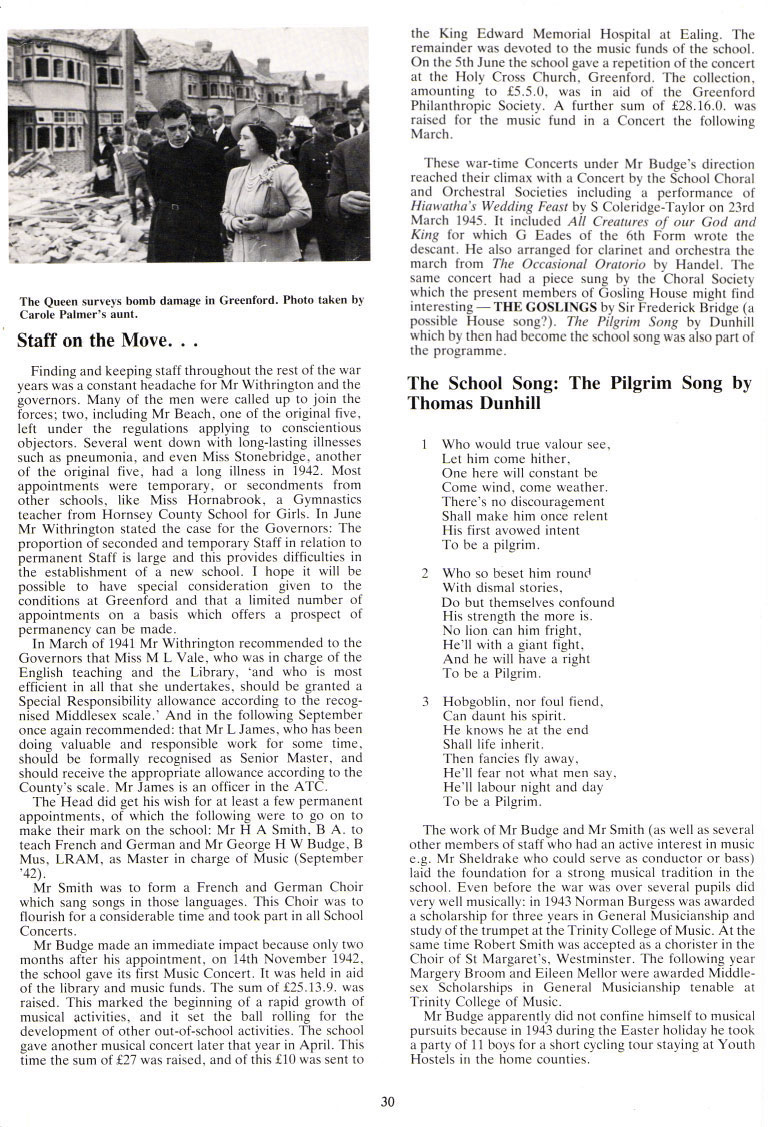
The Queen surveys bomb damage in Greenford. Photo taken by Carole Palmer's aunt.
Staff on the Move. . .
Finding and keeping staff throughout the rest of the war years was a constant headache for Mr Withrington and the governors. Many of the men were called up to join the forces; two, including Mr Beach, one of the original five, left under the regulations applying to conscientious objectors.
Several went down with long-lasting illnesses such as pneumonia, and even Miss Stonebridge, another of the original five, had a long illness in 1942.
Most appointments were temporary, or secondments from other schools, like Miss Hornabrook, a Gymnastics teacher from Hornsey County School for Girls.
In June Mr Withrington stated the case for the Governors:
The proportion of seconded and temporary Staff in relation to permanent Staff is large and this provides difficulties in the establishment of a new school. I hope it will be possible to have special consideration given to the conditions at Greenford and that a limited number of appointments on a basis which offers a prospect of permanency can be made.
In March of 1941 Mr Withrington recommended to the Governors that Miss M L Vale. who was in charge of the English teaching and the Library,
'and who is most efficient in all that she undertakes, should be granted a Special Responsibility allowance according to the recognised Middlesex scale.'
And in the following September once again recommended:
that Mr L James, who has been doing valuable and responsible work for some time, should be formally recognised as Senior Master, and should receive the appropriate allowance according to the County's scale. Mr James is an officer in the ATC.
The Head did get his wish for at least a few permanent appointments, of which the following were to go on to make their mark on the school:
Mr H A Smith, BA. to teach French and German and Mr George H W Budge, B Mus, LRAM, as Master in charge of Music (September '42).
Mr Smith was to form a French and German Choir which sang songs in those languages. This Choir was to flourish for a considerable time and took part in all School Concerts.
Mr Budge made an immediate impact because only two months after his appointment, on 14th November 1942, the school gave its first Music Concert. It was held in aid of the library and music funds. The sum of 25.13.9. was raised.
This marked the beginning of a rapid growth of musical activities, and it set the ball rolling for the development of other out-of-school activities.
The school gave another musical concert later that year in April. This time the sum of 27 was raised, and of this 10 was sent to the King Edward Memorial Hospital at Ealing.
The remainder was devoted to the music funds of the school.
On the 5th June the school gave a repetition of the concert at the Holy Cross Church, Greenford. The collection, amounting to 5.5.0. was in aid of the Greenford Philanthropic Society. A further sum of 28.16.0, was raised for the music fund in a Concert the following March.
These war-time Concerts under Mr Budge's direction reached their climax with a Concert by the School Choral and Orchestral Societies including a performance of Hiawatha's Wedding Feast by S Coleridge-Taylor on 23rd March 1945.
It included All Creatures of our God and King for which G Eades of the 6th Form wrote the descant. He also arranged for clarinet and orchestra the march from The Occasional Oratorio by Handel.
The same concert had a piece sung by the Choral Society which the present members of Gosling House might find interesting THE GOSLINGS by Sir Frederick Bridge (a possible House song?). The Pilgrim Song by Dunhill which by then had become the school song was also part of the programme.
The School Song: The Pilgrim Song by Thomas Dunhill
1
Who would true valour see,
Let him come hither,
One here will constant be
Come wind, come weather.
There's no discouragement
Shall make him once relent
His first avowed intent
To be a pilgrim.
2
Who so beset him round
With dismal stories,
Do but themselves confound
His strength the more is,
No lion can him fright,
He'll with a giant fight,
And he will have a right
To be a Pilgrim.
3
Hobgoblin, nor foul fiend,
Can daunt his spirit.
He knows he at the end
Shall life inherit.
Then fancies fly away,
He'll fear not what men say,
He'll labour night and day
To be a Pilgrim.
The work of Mr Budge and Mr Smith (as well as several other members of staff who had an active interest in music e.g. Mr Sheldrake who could serve as conductor or bass) laid the foundation for a strong musical tradition in the school.
Even before the war was over several pupils did very well musically:
in 1943 Norman Burgess was awarded a scholarship for three years in General Musicianship and study of the trumpet at the Trinity College of Music.
At the same time Robert Smith was accepted as a chorister in the Choir of St Margaret's, Westmimter.
The following year Margery Broom and Eileen Mellor were awarded Middlesex Scholarships in General Musicianship tenable at Trinity College of Music.
Mr Budge apparently did not confine himself to musical pursuits because in 1943 during the Easter holiday he took a party of 11 boys for a short cycling tour staying at Youth Hostels in the home counties.
page 30


 Page 30