THE BEST LAID PLANS. . .
At 11:15 on September 3rd 1939 the people of Greenford, gathered round their wirelesses, heard their Prime Minister broadcast to the anxious nation:-
I am speaking to you from the Cabinet Room at 10 Downing Street. This morning the British Ambassador in Berlin handed the German Government a final note stating that, unless we heard from them by 11 o'clock that they were prepared at once to withdraw their troops from Poland, a state of war would exist between us. I have to tell you now that no such undertaking has been received, and that consequently this country is at war with Germany.
That announcement and its consequences meant that Greenford County School was to have all the problems experienced by any school during the war but made infinitely worse by the fact that it was born at the outset of the Second World War indeed its birth was delayed.
Birth
The school did not open on September 14th as planned. For a while the appointed staff were not sure that the school would open at all as there were rumours that the building was to be used as a barrack or hospital!
If they did open would they have any pupils? As Mr Withrington put it,
'. . .enquiry soon showed that there was no panic rush of children away from the area. Over 80% of the parents indicated that they still wished their children to attend after the outbreak of hostilities, and the school was opened, on a basis of voluntary attendance, on 2nd October 1939.'
(The official opening by Lord Elton, which had been planned to take place on the 12th October, was indefinitely postponed at this stage.)
'The school opened with 208 pupils (not 145 as originally planned for) of whom over one third were evacuees from 28 other secondary schools.'
'There were four normal age first forms, two over-age first forms, and two second forms. All second formers were from other schools. These pupils formed the 'top' of the school as it grew up and provided the problem of developing a loyalty in a compact group of pupils who did not think of themselves as ours. The problem of temporarily absorbing staff seconded front other schools (such as Ealing County Girls' and Ealing County Boys' and schools in Hornsey and Chiswick) began and stayed with us for the next six years.'
Day One
The first day is recalled in the first edition of the school magazine Prospice published in 1947:-
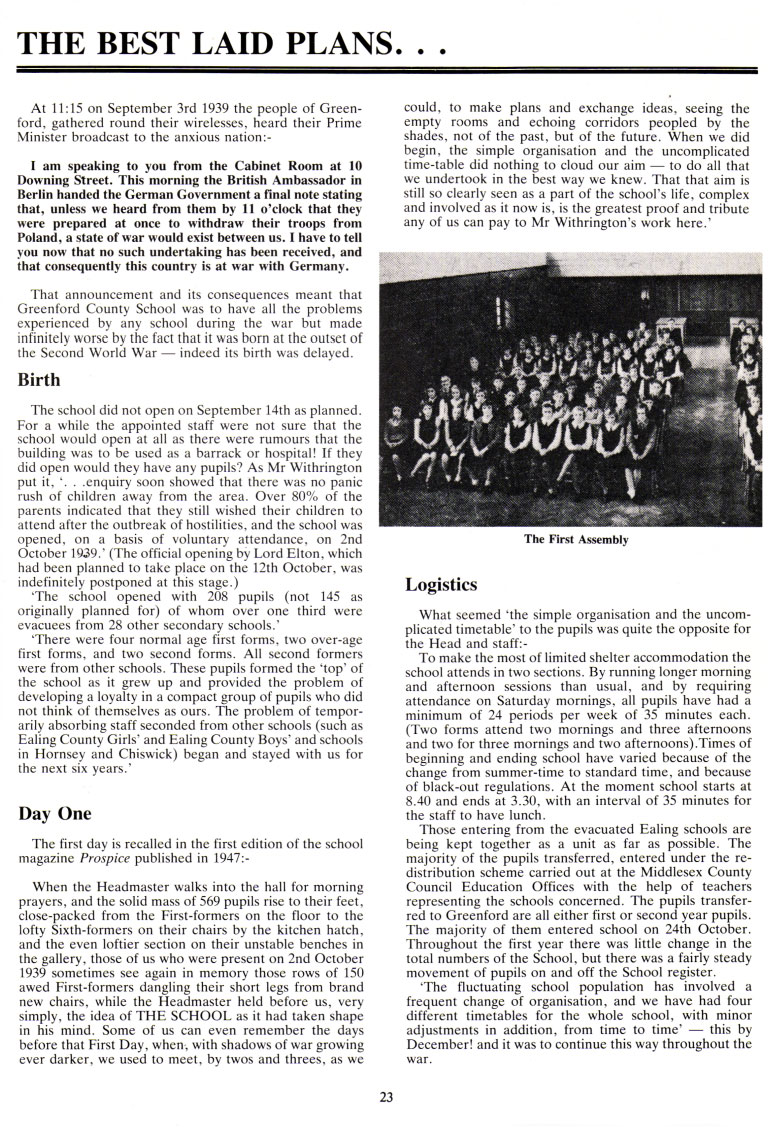
When the Headmaster walks into the hall for morning prayers, and the solid mass of 569 pupils rise to their feet, close-packed from the First-formers on the floor to the lofty Sixth-formers on their chairs by the kitchen hatch, and the even loftier section on their unstable benches in the gallery, those of us who were present on 2nd October 1939 sometimes see again in memory those rows of 150 awed First-formers dangling their short legs front brand new chairs, while the Headmaster held before us, very simply. the idea of THE SCHOOL as it had taken shape in his mind.
Some of us can even remember the days before that First Day, when, with shadows of war growing ever darker, we used to meet, by twos and threes, as we could, to make plans and exchange ideas, seeing the empty rooms and echoing corridors peopled by the shades, not of the past, but of the future.
When we did begin, the simple organisation and the uncomplicated time-table did nothing to cloud our aim to do all that we undertook in the best way we knew.
That that aim is still so clearly seen as a part of the school's life. complex and involved as it now is, is the greatest proof and tribute any of us can pay to Mr Withrington's work here:
Logistics
What seemed 'the simple organisation and the uncomplicated timetable' to the pupils was quite the opposite for the Head and staff:-
To make the most of limited shelter accommodation the school attends in two sections. By running longer morning and afternoon sessions than usual, and by requiring attendance on Saturday mornings, all pupils have had a minimum of 24 periods per week of 35 minutes each.
(two forms attend two mornings and three afternoons and two for three mornings and two afternoons).
Times of beginning and ending school have varied because of the change from summer-time to standard time, and because of black-out regulations.
At the moment school starts at 8.40 and ends at 3.30, with an interval of 35 minutes for the staff to have lunch.
Those entering from the evacuated Ealing schools are being kept together as a unit as far as possible.
The majority of the pupils transferred, entered under the redistribution scheme carried out at the Middlesex County Council Education Offices with the help of teachers representing the schools concerned.
The pupils transferred to Greenford are all either first or second year pupils. The majority of them entered school on 24th October.
Throughout the first year there was little change in the total numbers of the School, but there was a fairly steady movement of pupils on and off the School register.
'The fluctuating school population has involved a frequent change of organisation. and we have had four different timetables for the whole school, with minor adjustments in addition, from time to time' this by December! and it was to continue this way throughout the war.
page 23


 Page 23