What might have been
Sorting through plans of our site, it is interesting to note various schemes that never quite got off the ground.
What happened to the 60 by 30 feet covered way linking the gym with the main building?
Where is the separate music suite crossed out on another plan or the caretaker's house removed from yet another?
Our boys are still waiting for inside toilets and individual shower cubicles.
For the future, it must make sense surely to replace the huts by sounder structures and if Ealing is serious about community education, funds will have to be found to improve our facilities and to maintain our existing buildings so that they last at least another fifty years.
Points of interest
Notice that the entrance hall was originally much larger than it is today.
It was reduced in size in 1974 to produce extra office space on the right (as you go in) and on the left an Evening Institute Office.
This has now been further divided to make a waiting lobby and a small store room.
The Evening Institute now uses the main office.
Connoisseurs of wood veneers will be interested to note that the assembly hall is panelled in sapeli mahogany with narrow strips of Sebrano dividing it into a bold rectangular pattern.
The radiators are recessed in wooden frames of the some wood.
The bricks used are known as multicoloured reds supplied by the Dorking Brick Co. it is also worth noting that all the exterior corners of the building are rounded using two and a quarter inch bull nosed bricks!
Compare them with those of the newer buildings which are not.
An interesting exercise for pupils new to the school would be to look at the 1939 plan and to find out the present usage of the following rooms, all now differently employed:
GROUND FLOOR
a) Classroom 7 and Lecture Room
b) Library
c) Geography, Classroom 5
d) Store next (c)
e) Timber Store
f) Manual Training
g) Forge
h) Medical Inspection
i) Senior Mistress
FIRST FLOOR
a) Women Staff Common Room
b) Prefects' Room
c) Art Room
d) Typewriter Store
e) History C.R.I4
f) Evening Principal's Room
g) Evening Classes Store
h) Domestic Science Room
i) Men Staff Common Room
Architectural Journals
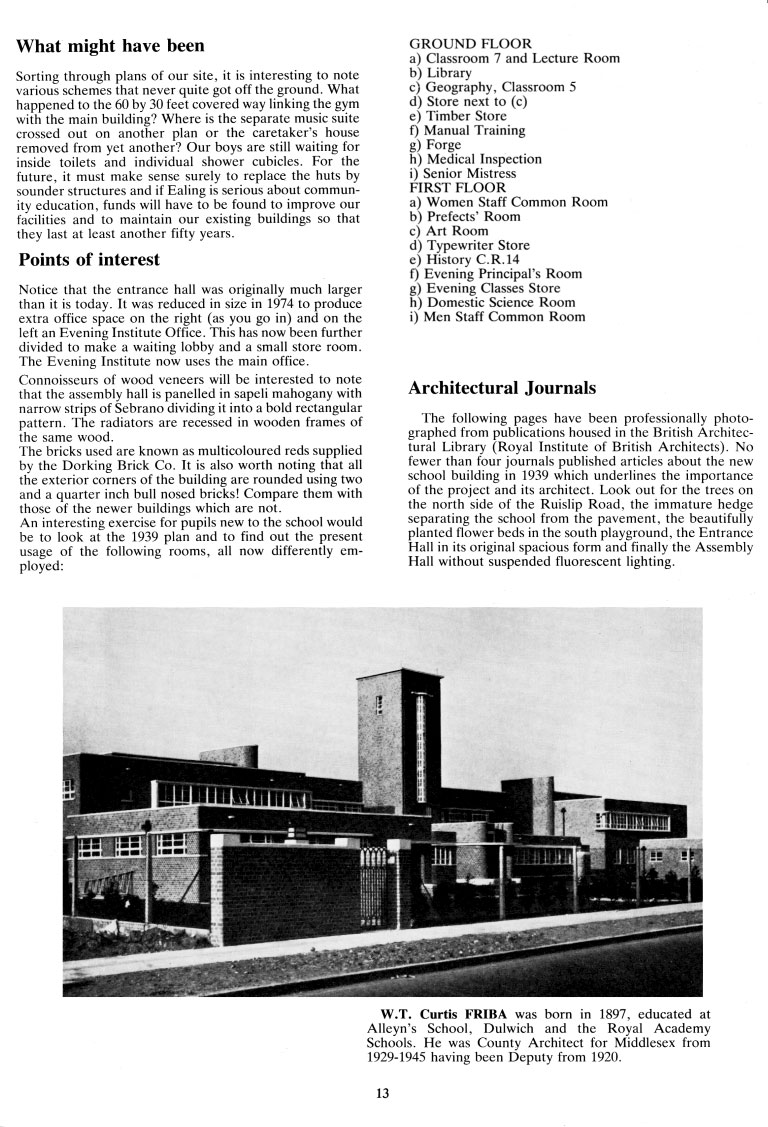
The following pages have been professionally photographed from publications housed in the British Architectural Library (Royal Institute of British Architects).
No fewer than four journals published articles about the new school building in 1939 which underlines the importance of the project and its architect.
Look out for the trees on the north side of the Ruislip Road, the immature hedge separating the school front the pavement, the beautifully planted flower beds in the south playground, the Entrance Hall in its original spacious form and finally the Assembly Hall without suspended fluorescent lighting.
IMAGE
W.T. Curtis FRIBA was born in 1897, educated at Alleyn's School, Dulwich and the Royal Academy Schools.
He was County Architect for Middlesex from 1929-1945 having been Deputy from 1920.
page 13


 Page 13